Image
One of the things about my life that I am most delighted by is the fact that I’ve gotten to visit all fifty states. I almost said “proud of” but really there is little I did to merit it. Most I visited because my parents took us camping there. Or a professional development conference took me. Or a CGS formation course. Or a work client. Then suddenly I was approaching my fiftieth birthday and I realized I only had a few states left and the “Fifty Before Fifty” effort became more focused. I started by coming up with a rubric for what counted as a “visit.” Did I have to stay overnight? Did pulling over at a gas station count? How about a layover in the airport? Holding myself to a high… but not too high…. bar, I finally decided that I did not need to stay the night but I did need to have “done something touristy” there. I needed to have seen something the state was known for. And airports didn’t count.
My final state was Utah. I was coming up on my fiftieth birthday within a couple weeks and time was running out, so I did that rare thing and stopped waiting around for an invitation to speak there. (Not a lot of Catholics in Utah!) I talked my sisters into coming with me to Zion National Park. Gosh, that was a great time. Mission complete!
Except for Delaware. I noticed this when I began to put together “Ann’s Photo Album to All 50 States.” Delaware was but a faint memory. I went there one afternoon with some fellow high school teachers in Summer 1992 as part of an NEH grant on “Pursuing Happiness with Franklin and Washington in Adam Smith’s Theory of Moral Sentiment.” Yes, indeed, one afternoon four of us decided that happiness would be better pursued by going to the beach than reading any more of Adam Smith, and we drove from Maryland to somewhere in Delaware. I don’t remember where. And we saw a dolphin. At least I think that is what happened. After much searching, I was able to find one picture of my fellow teachers on the beach to include in the photo book. I’m pretty sure we were in Delaware.
Okay, that is likely way more information than you wanted to know about my life, but I sense that the background will help make some small sense of the next thing that I am about to write which is that yesterday, I teared up for a moment when I needed to send an email to a board of trustees I was slated to work with this coming Fall and let them know I would not be able to facilitate a workshop at their annual retreat in Delaware.
This email came in the middle of a week when I’d been originally scheduled to be with the wonderful NACPA group members in New Orleans but had had to cancel, while plotting to be in Detroit this weekend with a fantastic Jesuit men’s group that I also had to cancel. And next week I was supposed to wrap up my eight-year term on the board of the Association of Theological Schools in Pittsburgh, but I won't be there.
On one hand, it is all good. I’ve been to all fifty states, right? Even Delaware. (I think.) And who wants to fly right now? Except that for me, travel has long been part of what I love most about being alive. I love seeing new places. I even love seeing old places I haven’t been for a while. I like the people I meet on these adventures and am always walloped by how good they are and how interesting. And sitting at my desk to send that email—even though the day was beautiful and the sun was out and my tea was perfect and I was feeling physically well—it just felt like a huge “letting go.”
But I harbor no illusions this Easter season in thinking I am alone in that experience. I know that many of you are also facing huge acts of letting go. You probably don’t care about Delaware. (Sorry, Delaware. That sounds harsher than I mean.) But there is a house or a family farm. A job. A school. A motherhouse. A relationship that is in the process of changing in a major way. A church. A country. An identity. A sense of independence. And I find myself thinking of Mary of Magdala whose presence permeates this whole Easter season, and the scene of her shedding a tear at the tomb, I suspect even after she sees the Risen Christ, but at that moment when he says, “Stop holding onto me.”
I hope Ron Rohlheiser is okay with me borrowing the first couple lines of his poem here:
“I never suspected
Resurrection
And to be so painful
To leave me weeping
With joy
To have met you, alive and smiling, outside an empty tomb
With regret
Not because I’ve lost you
But because I’ve lost you in how I had you…” 1.
I hope he is also okay with me suspecting that these lines apply not just to the Resurrected Jesus but to every stage of life itself. It’s not that there isn’t still beauty and joy in life. It’s just that it is not to be found in the way it was before, and it is going to take some time to get used to that. Again, how gentle of God that there is no rush. Forty is a symbolic number here. It represents simply whatever amount of time it takes for letting go / change to happen and to let this new life be exactly that: a new life.
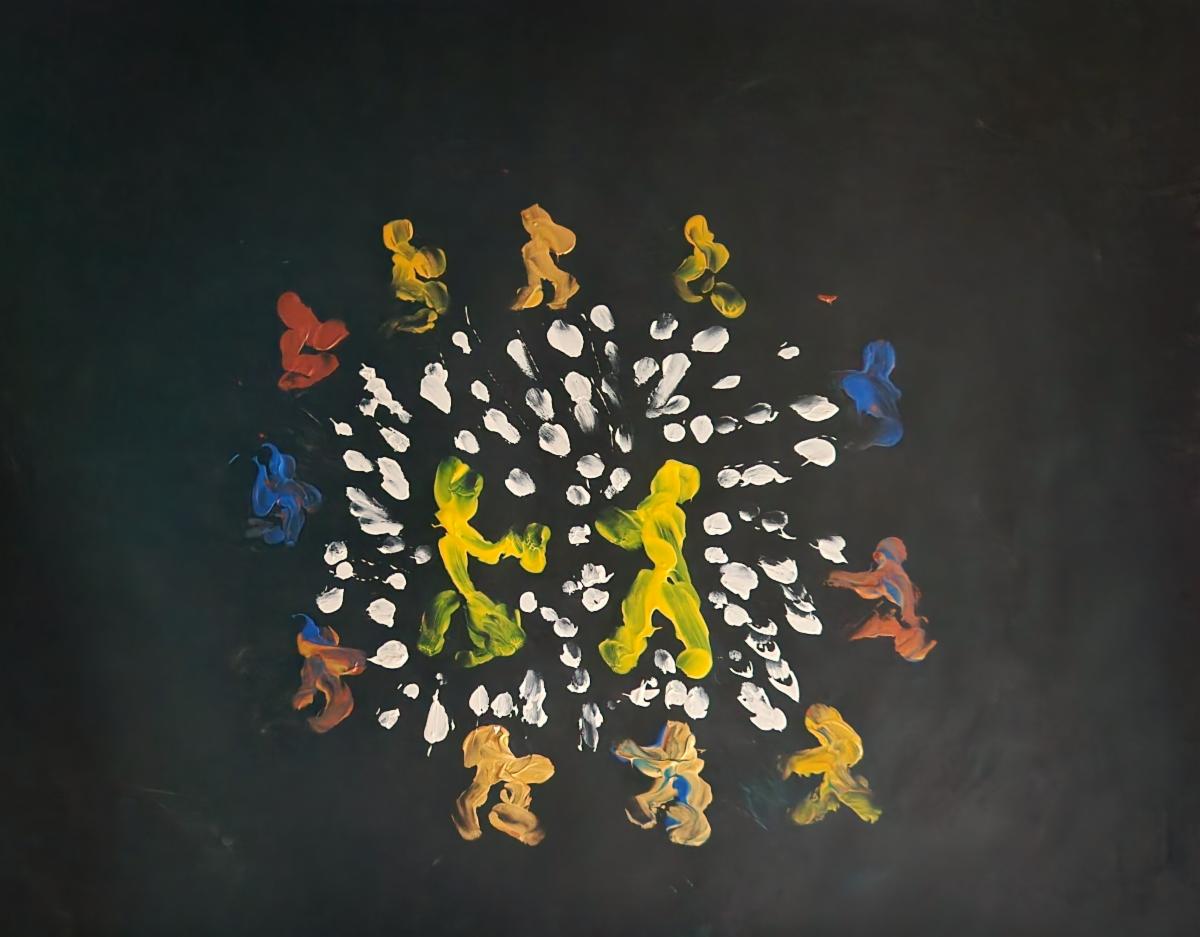
A few days ago, my friend Clarence posted the picture that I’ve attached to this newsletter. I am certain he did not quite have the scenario in mind when he painted it that I had when I saw it, but it reminded me of Mary of Magdala and this new Risen Jesus—their longing to cling to one another and also the distance between them in this time of transition. (“Stop holding onto me.” John 20:17) Personally, what was especially significant was the sight of all the people around them in the darkness encircling them as the two enter this new way of relating. They are not in the written story, maybe because the communion of saints is often invisible. But I like those people because I know some of them. They are all of us when we pray for others who are in that place of letting go. They are all of you who are praying for me this week as I let go of Delaware, New Orleans, Detroit, and Pittsburgh. They are partly me when you let me know what you are letting go of and I pray for you.
I used to say that more casually. “I’ll pray for you.” Now, like many of you, I actually keep a list and it is taped to my printer where I can easily see it from my desk. You have done such a good job praying for me in my own season of letting go, I have learned from you how this can be done more intentionally and diligently than how I was doing it. When I am confronted with something that life is asking me to let go of (or when I am irritated because my printer is jammed again—another likely possibility), I offer it up for all the names and situations on that list.
Teilhard de Chardin was keen to note that when we come to the altar with bread, we are bringing all of our activities throughout the week—all the things we’ve done with the goods of the earth for the building up of the Reign of God. But when we approach with the wine, we are bringing our “passivities”—all the things that life has handed us, not by choice. Our experiences of diminishment, illness, aging, disappointments. All the things of which we are called to let go. Like with the bread, we hand over the wine and say, “God, in unity with Christ, I’ve gone as far with this as I can go. I give it to you. Your turn.” And we trust that in some mysterious way, God will be able to do something with our passivities as much as with our activities on behalf of the world God dreams to bring about. It all still matters. It all still makes a difference.
May your Easter season continue to be a blessing, whatever it is you are letting go of right now. May it be a time of surprising joy and newness in the space that you least expect it.
- Ronald Rohlheiser, The Holy Longing (NY: Doubleday, 1999) p. 166
- Photo credit: Clarence Heller - http://clarenceheller.com/connecting-new/