Image
Lent begins each year with the story of Jesus going into the desert for forty days. We know he fasted and was tempted there. We even have a good sense of what the three temptations were. But we don’t have a very good idea about what happened the remainder of the time.
I realize that might be kind of a quirky thing to spend one’s time wondering about, but (as you might already have guessed) it has been on my mind of late. Forty days is a long time to ponder three temptations.
I know that because I’ve been trying. I mentioned a couple of weeks ago that I’m doing the 19th Annotation of the Ignatian Exercises this year and we started Lent following Jesus into the desert and then I chose to hang out there a bit longer. After deciding not to jump off the temple parapet or bake bread or take over other kingdoms, what exactly did Jesus do during those forty days? Was there something on the other side of the temptations?
I suspect there might have been. That maybe on the other side of the wrestling with the devil, a calm set in. Clear what he was NOT about in this world, perhaps Jesus spent time becoming more aware of what he WAS about in this world. Perhaps he had a vision of what God DID have in mind for the planet.
Thinking about Jesus’ quiet time in the desert has run parallel to me thinking about Pierre Teilhard de Chardin’s quiet time in the desert. I’ve been working on an online module about him for catechists in the Catechesis of the Good Shepherd movement that will launch sometime in 2027. It is slow going because I can’t read him quickly anymore. Geez, what am I talking about? I’ve never been able to read him quickly even when I had a whole brain. He is a very dense writer always coming up with new words I’ve never heard before. Words no one has heard before. But I suspect it was because, like Jesus, he was a desert mystic and had visions of what the world was on its way to becoming, but visions for which there simply weren’t words yet.
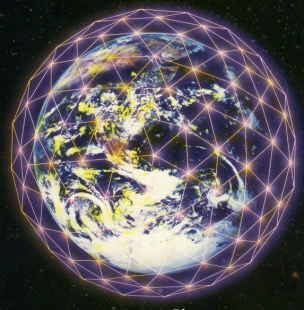
One of Teilhard’s words for what he saw in the deserts of Mongolia and China was “noosphere.” Bet you haven’t come across that in everyday talk, right? As someone studying evolution while doing paleontology, Teilhard saw the earth as passing in time from a “geosphere” (a.k.a. “the mineral world”) to a “biosphere” (a.k.a. “the plant then animal then human world”). And he believed it was now passing into a “noosphere” based on the Greek nous meaning “mind.” The noosphere is a layer of "mind" encircling the earth, just as real as the layer of minerals or plants, but invisible. It emerges from human consciousness—a web of shared human thought, meaning, and culture that binds humans together.
Some have noted that Teilhard’s writing about the noosphere almost sounds like a foreshadowing of the internet or the emergence of A.I., and that it is possible for such a layer of thought to emerge yet it leads to greater fragmentation and violence. Teilhard, ever the hopeful Christian, understood that in God’s Plan the noosphere was both animated by and drawn toward “amorization”—love. Ultimately within the human person there is a drive to love and to bind to one another in unity, even as we remain different people. One of Teilhard’s most well-known lines is that “union differentiates.” Real love never absorbs the other person and makes them disappear, but makes them more fully themselves.
In working on this unit on Teilhard, in this midst of this Lent, I sense I’m experiencing just a bit what lies on the other side of battling temptations. After the temptations grow less attractive and go more silent, there is something else hidden that begins to shimmer in the desert. Maybe noosphere isn’t your preferred word for it and amorization sounds just bizarre. But that doesn’t mean it isn’t there, even if sometimes it feels faint. I have been feeling it and don’t have a better word exactly. “Amorization” feels too snazzy and “love” feels too Hallmark-ish. But there is a layer of compassionate wisdom growing around the earth that you won’t be able to pick up watching the news or scrolling social media. It only makes itself known if you hang out for a while in the desert.
The network can be traced to Meghan who sent me two soy candles to light when it is darkest, but this reminds me to send a few votives to Sarah who has three children and just started chemo for breast cancer. Sarah was already praying for me and dropped a gift on my porch before her own diagnosis but now we are linked in a new way, making an offering of whatever we are experiencing for those who have been snatched in Minnesota. For peace across the Middle East. For the conversion of our American leaders to something that resembles actual love. Can’t see any sign of it happening on the tv screen but in the desert what prayer can make possible still shimmers. Still forms a connection. And some of the energy I felt in the video of Ethiopian Franciscans dancing during my friend Ed’s visit continues to bind me to them though we have never met, and to the people at Old St. Pat’s in Chicago where Ed sometimes presides, and my dear friend Diane loved to worship, and now where her dear friend’s son Tim has had Mass offered for me, even though we’ve only met once. A whole litany of names could be lifted up here. Each as dear as the last and each, by their gesture of love toward me has reminded me to better love another.
On the other side of temptation, it doesn’t feel happy or perky. There are a lot of people when you begin to hear their struggles, you realize their situation is a great deal more difficult than your own. And what connects you at that point is a shared experience of loss or sadness or disappointment or grief, but then also a shared sense of beauty and profundity and depth. And, yes, love.
Following the death of our mom, my sister told me she’d learned that “poignancy” was a new feeling that only emerges with maturity. It is a feeling that required the capacity to feel multiple feelings at the same time, and we can’t always do that earlier in life. But on the other side of temptation—on the other side of whatever it is that would keep us shallow, whatever would meet our desires quickly—there is the possibility of experiencing complexity, which ironically is also something Teilhard tried to describe. He called it “complexity-consciousness.” Clearly this was a man who loved many syllables.
But he seems to have been onto something in the desert. This Lent, maybe you will want to hang out there a while, too.
Image taken from https://teilhard.com/ Note that on the cover page of this website is a video called Teilhard: Visionary Scientist that is currently playing on PBS Passport, but only till April. You might want to watch it this month before it disappears.