Image
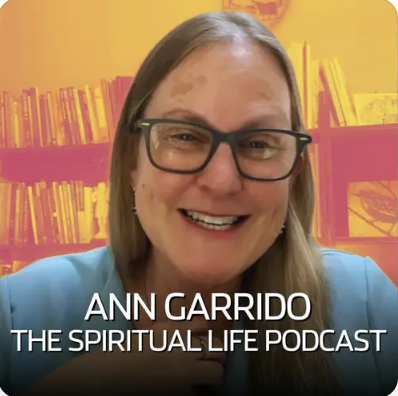
It was really an honor to be interviewed by Fr. Jim Martin for The Spiritual Life. It was also slightly intimidating. He asks good and interesting questions, but BIG ones. Ones that are hard to give clear answers to. Especially when you are missing that part of the brain where you used to keep your favorite vocabulary and this thing called “coherence.” Especially when you are simultaneously debating in your own mind, “Do I really want to say that in public or not?” Especially when you know that what you are saying might be easily misunderstood and you might come off as a bit unhinged. For example, saying aloud that you sense God is asking you offer up your life for the good of your country. Kind of a crazy statement.
I don’t think I communicated particularly well in the podcast what I was actually trying to say on that topic and maybe would like to try again. That’s the best thing about authoring a newsletter, right? You get to continue your own conversations with yourself.
Talk about “offering up” sounds like something straight out of the 1950’s, and as Fr. Jim and Maggi mention at the end of the podcast, it could make a lot of hearers a little skittish. Geez, it even makes me skittish. Growing up, whenever I had to deal with a situation I didn’t want to deal with (eg. undesirable school lunch, having to babysit when I wanted to go out with friends), I was often told to “offer it up for the poor souls in purgatory.” Hearing that phrase made it feel like my voice wasn’t being heard. My point dismissed. And who were those poor souls in purgatory anyway? Why would me eating a soggy bologna sandwich with mustard be helpful to them?
Sometimes, though, as Jim and Maggi allude to, regularly being told to “offer it up” could do a person real spiritual damage. It might keep someone in a state of suffering unjustly. It could stop one from trying to change a situation that genuinely needs a change. In the Gospels, Jesus never tells anyone who comes to him in search of healing to “offer it up.”
But at the same time there are circumstances in life where unfortunate things happen that just happen. They feel like they have no purpose to them. Whether they do actually have purpose or not depends on what we ourselves make of them.
One of my favorite books is Les Miserables by Victor Hugo. I read it as a college student in Sierra Leone when the afternoons were so steamy hot that there was little else one could do but lay down with a good, long book. Les Mis was both: good and looonngggg. In one memorable scene, an angry Jean Valjean, who has recently been freed from prison, is fed dinner by a gentle bishop and offered a place to spend the night. Instead, he escapes with the bishop’s silver dishes. Valjean is caught by the police officer Javier and dragged back to the bishop’s house. At that point the bishop could have had Valjean put away for the rest of his life, but instead the bishop says to Valjean, “Oh, my friend, you snuck away early! You remembered the dishes, but you forgot the candlesticks I gave you.” Valjean’s whole life is turned entirely around, much to Javier’s dismay. His future will be very different than his past.
Pardon me if I’ve got a few details askew here. It has been a while not only since I read the book but even since I’ve seen the musical. But this is the point that has always stuck with me: You could rightly say that the bishop was robbed. He had no control over that. But he decided to instead offer what was already being taken from him as a gift and in doing so, gave the act another meaning and Vajean a different future.
The bishop’s move was, of course, not original. It was one learned from Jesus’ playbook. In the Gospels, we meet a man who lives in an oppressive Roman empire. Once he started preaching about the Kingdom of God, his life was going to be snatched from him whether he liked it or not. But he decided it wouldn’t be stolen. On the night before he dies, Jesus tells his friends that what they are about to see the next day should be understood in another way. The Romans can come for him. Will come for him. But too late. His body and blood—his whole self—is already being offered to them as a gift.
Glioblastoma came into my life entirely as a surprise. As far as I know, there really wasn’t anything I could have done to prevent it. Certainly, by the time I was diagnosed, there wasn’t anything I could do to avoid it. Glioblastoma had come for me. But I do believe that as Christians, Jesus tells us that there is always get a window of space in which we don’t lose power. A window in which we get to choose what we will do about what feels like a robbery. We get to say, Before this is taken from me, I’d like to give it as a gift. And what I sensed last autumn at the time of the diagnosis was God asking if—given the situation being what it was—I’d like to make of the situation a gift, which really is another word for an “offering.” For whom? For my country.
Not wanting to come across as too political on the podcast, I was perhaps fuzzier than I could have been about something that is actually quite clear in my own mind, which is that in the U.S. right now we live in the shadow of a president who is dying. I say that not as someone prone to conspiracy theory. I have no secret information on this matter. Just the everyday visual data of an elderly man who appears in consistently poor physical and mental health.
My perception is that the president does not know how to die and is quite frightened of death. And as a result, his own internal chaos is wreaking tremendous chaos on the wellbeing of a nation. Yes, gas and food prices negatively impact us all, but that’s not really the chaos I’m concerned about. I’m talking about the moral and spiritual wounding of a whole country in ways I do not know how we shall recover from. The damage that has been done is beyond what any tools I’ve got in my belt as a conflict mediator can fix. But in the moment of my diagnosis, I felt God suggest I could still do something and ask whether I would I be interested in doing that. I could choose to make of this season in my own life a gift.
I’d like to be very clear that I also do not know how to die and find my own diagnosis quite frightening. But, with the help of God, I’d like to offer the closing season of my own life as a witness to another way of going about death in which fear and terror are not the driving forces. In which there is honesty and transparency and a real picture of what is going on. In which relationships move deeper and become more connected rather than shallower and more polarized. When I said in the podcast that I felt like God had asked me to offer up my life on behalf of my country, this is what I was trying to say, even if it came across a bit jumbled.
What I hope was not jumbled in my comments is that it has been a really meaningful journey thus far. It has been sad, but it has also been sweet. Overwhelming, but also full of compassion. Confusing, but also clarifying. Occasionally stultifying, but also endlessly mysterious. As human beings, we have the amazing capacity to feel more than one thing at the same time, and if we choose not to do battle with the complexity of our feelings but give them all a place to dwell and chat with one another, it makes for a richer life.
When death comes—and who knows when that will be for any of us really, right?—I just know that I’d like the story told at my funeral not to be one of robbery but of offering. I’d like it to be said my life was never snatched from me before I’d already given it in advance to show another way of responding to the mystery of death than the one in the news every day.
I know that many of you are also already making an offering, too, by the way that you are living this particular season in your own lives and I’m learning from your playbook as well. Let us continue to pray for one another as we choose to let go of not only our dishes but our candlesticks in hopes of another kind of world.