Image
Here we are in the peak of summer heat when Jeremiah often chooses to visit the lectionary and then linger longer than you hope he will stay around because he is whiny and dour and always comes bearing bad news. Who really wants him as a spiritual houseguest?
Because I usually preach for The Word early in the month, I landed a particularly long passage of his for Monday, August 3. At first, it was just confusing as to what was going on precisely because it IS a rather long passage...for which I will offer a CliffsNotes version momentarily...and expects you've read much before this event. But the more time I spent with the passage, I realized how it frames quite hauntingly the debacle that we face in our own time.
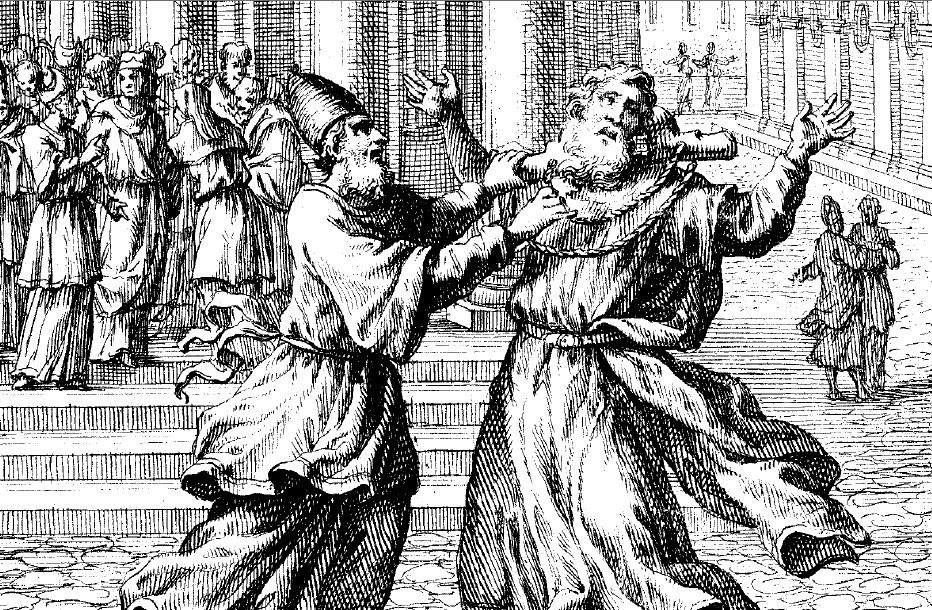
Here is the CliffsNotes version: Jeremiah is in the temple in Jerusalem alongside another prophet whose name is Hananiah. Jeremiah has arrived to the temple in a strange way with an oxen’s yoke upon his neck, though maybe by this point we should not consider this surprising. Several chapters earlier Jeremiah reclaimed underwear he had buried along the river Euphrates as a sign of the peoples’ diminished pride, so why not now walk around with a yoke?
The yoke to Jeremiah represented oppression. In the ancient Mideast, when the emperor’s army conquered another, it was not uncommon that the defeated soldiers would be forced to parade through a “yoke” of raised swords as a sign that they were now like cattle who had been castrated and forced into servitude. And when Jeremiah entered the temple this way, he meant it as a message to the people that they were about to be conquered by King Nebuchadnezzar of Babylon and hauled off from their homeland.
No wonder the people descended into panic and no wonder another prophet, Hananiah, stepped forward and broke the yoke over Jeremiah’s shoulders. No wonder he sought to encourage the people by promising that God was about to free the people from Nebuchadnezzar in two years’ time and bring back the articles stolen from the temple. Who doesn’t want to be a prophet of hope, announcing a coming season of peace?
Except that Jeremiah knew that what Hananiah had to proclaim was not true in his time. And it wouldn’t be true until there was some genuine change among the people. They would not be freed from the Babylonians until they had time to really come in contact with the depth of their culture’s… no other word for it: sin. And that was, apparently, not going to happen fast because it rarely happens fast. They needed to become aware of its true effects and repent before they were free again. As a sign of that, after Hananiah broke his wooden yoke, Jeremiah now takes on a yoke made not of wood but iron. So inflexible and harsh. It will not be two years until the people are free again. As you and I know, it’ll be forty.
But we know that because we don’t live in 2600 BCE but 2026 CE, and we know that the book is called Jeremiah, not Hananiah. We know who ended up predicting rightly and who ended up being wrong about how history would unfold.
But the people of the time? How would they have been able to tell? Who would you listen to—hopeful Hananiah or the irksome and depressing Jeremiah? A prediction of two years till this will all be over…. Or a prediction of oppression without an end in sight? I know which one would make me feel better, but that’s not always a great marker of who has the best read on the situation.
The reason I was drawn to this reading after some time with it was because it feels to me so similar to the situation all of us find ourselves in during our present moment in history. Like the people of Judah so long ago, we do not live in our own future. We turn on the news and find ourselves in the midst of political analysts. (And what really were Jeremiah and Hananiah in their own times but political analysts?) Some continually tell us we are on the edge of better times and some continually tell us we are on the edge of worse. How can we tell who the real prophets are? Who is telling us the truth?
In the preaching, I mention briefly three points but here I’ve got a little more space and less time pressure, so let me expand a bit because I think that these are three things we should be talking about right now amongst ourselves when we find ourselves confused on the matter of how we can tell who is really telling us the truth.
We can’t. We can’t always tell who is telling us the truth in any given moment. To be human means to live in ambiguity, which to do well in every age always requires the virtue of humility. That doesn’t mean we should become skeptics, unwilling to believe anything at all because, really, how can you tell? If that were to happen we would remain frozen and unable to make up our minds about how to act, and we do need to act. This is necessary for our survival and thriving as a species. If every morning we stood on the street corner wondering, “Is that car really headed in my direction or is it a figment of my imagination?” we are never going to be able to cross the street, and we need to be able to cross the street to get anywhere. But it does mean we acknowledge none of us has access to the whole truth of any given event while we are in the present tense. As my friend Eileen often reminds me, the daily news is always only the first draft of history. Or as Jeremiah says in the reading at hand: “The prophet who prophesies peace is recognized as truly sent by the LORD
only when his prophetic prediction is fulfilled.”- Given that we live in the present and not the future, the wisest thing we can do right now is consider which voices should carry more weight in our lives. Chances are that if a prophet / political analyst / politician / leader tells us only what we want to hear… if they make us feel comfortable and unchallenged to make any changes that will affect our lives, they are more likely to be a false prophet like Hananiah. Yet, if, like Jeremiah, their words confront us with changes needing to be made that we probably aren’t going to like because they cost us or inconvenience us or make us uncomfortable, chances are more likely that the person is a true prophet. And if they cost the speaker themself something—for instance, if the one speaking is saying something that will make themself less popular among their hearers—chances are even more likely that they are a true prophet. The character and courage of the person who seeks to lead the people is the best indicator we’ve got to who is telling us the truth. Always look for character.
- Since our short-term options to be able to tell who is the prophet are limited, the noblest thing we can do is to commit to a long-term valuing of truth as a society, recognizing that no society can thrive if it doesn’t value truth. It is possible that even Hananiah thought he was telling the truth about what would happen and if that was the case then, really, only time would be able to tell, but more often what distinguishes a false prophet is that they themselves know what they are saying is inaccurate but they live in the midst of a people who value consolation more than the truth, and they give the people what they want. Such a prophet/political analyst/politician/leader lives in a culture that accepts lying as a norm and makes it okay not to tell the truth. Such a culture dismisses lying as just something that happens in daily life and isn’t much of an issue. If a people doesn’t expect its prophets/political analysts/politicians/leaders to be honest, then they won’t be, and we all end up living under the iron yoke of constant distrust, unable to count on what anyone says.
If the book of Jeremiah has anything to teach the modern age it is that societies that don’t value truth will always live under an iron yoke until they suffer enough to change their ways, and the longer it takes for that change to happen, the longer the oppression they continue to suffer. Not because God is punishing them but because the way of life that they’ve opted for as a people is inherently a punishing one.
In the case of the people of Israel, the yoke was eventually broken. Hananiah was not wrong on that front. And he was not wrong about wanting to give the people hope. Hope is important. What he was wrong about was the two-year window that gave the people reason to hope without any change on their part. That change did eventually happen, but for the people of Judah it took the length of a whole generation. May it not take so long in our own.
++++++++
If you’d like to listen to my preaching for Monday, June 3, you can listen to it here.
Photo Credit: Johann Christoph Weigel, 18th century engraver