Image
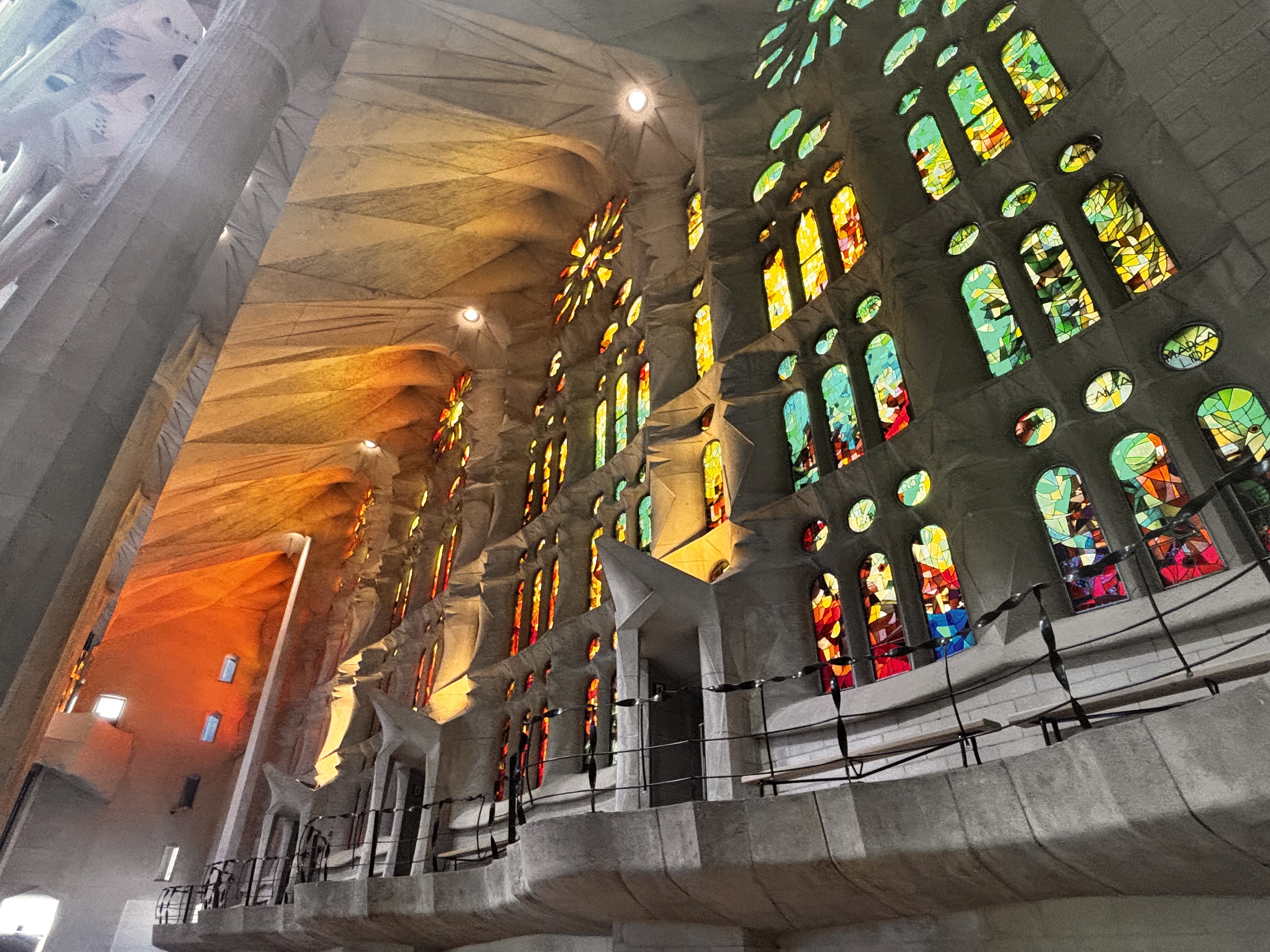
The Bible opens with the story of the Garden of Eden. A story about the beauty of the natural world that God created for us to romp around within to discover our own calling as humans. Given the harshness of daily life as adults, the Garden often feels like something of a far distant past. Perhaps something that has never existed at all… only a figment of our imagination. But then there will come these moments that open windows to the Garden and remind us of the kind of life God has dreamed for us from the very beginning. Last week was such a window opening for me.
Going to Barcelona has long been a bucket list destination for me both because of the Sagrada Familia and (as a catechist of the Good Shepherd) for its Montessori history. Realizing this hope was finally made possible last week by my friend Sheila who figured out all the travel logistics and lodging and museum tickets with that brilliant mind of hers and then accompanied me on the journey all the way from the Atlanta airport and back. If any of this planning had been left to me or if I’d had to go it alone, I think I would have made it as far as the Hartfield-Jackson TSA-Pre line and then had to turn around from brain overload. But this is classic Sheila. She knows how to make dreams happen, even when the dreams happen to be a little unusual.
I’m not talking about Sagrada Familia part here. No, lots of people have that one on their bucket lists. Apparently even the pope. We had zero idea that the dates we picked for our June excursion overlapped with the 100th anniversary of architect Antoni Gaudi’s death and that the pope, too, had planned a visit. One that involved candlelight and fireworks and a huge drone display of Gaudi’s face in the sky. Apparently after such a display, everyone in the world decided to visit on the same Saturday we did.
But what surprised me was that visiting the Sagrada Familia is kind of like visiting a church turned inside out with all of the ornate statues and artwork you might typically find inside a church building adorning the outside so that everyone can see the Christian story even if they never enter. But then, if they are able to enter inside the building itself, they are welcomed with a beautiful simplicity, like being inside a tall forest—with the pillars shaped as tree trunks and the water color windows filtering light as if through branches. And even though there were thousands of people coming and going throughout the day, it remained remarkably peaceful and largely quiet inside. Like the Garden of Eden before the Fall. A place where the window was opening for many.
But, of course, there were a few more obscure places also on my list beyond Sagrada Familia, and Sheila was so patient with my obsession here because these places didn’t tower over you like a church as large as the St. Louis Arch. In fact, they were a little (or a lot) hard to find. In the Catechesis of the Good Shepherd movement, we know from Maria Montessori’s own writings that it was a Vincentian priest in Barcelona—Fr. Antonio Casulleras—who first saw her pedagogical approach as uniquely aligned with education in the faith and not just education in mathematics or geometry or writing, etc. Casulleras worked with the women’s branch of the Vincentians—the Daughters of Charity—in collaboration with the local Catalan government educational agency to envision what Montessori Catholic education might look like.
One of the first testing grounds was at the La Maternitat complex which is one of the hardest places to find on the map of the earth. The initial atrium did not end up remaining there for long, but it had enough success that Montessori sent one of her most experienced companions, Anna Maccheroni, to Barcelona to oversee the expanding effort and for the abbot of the famous Catalan monastery of Montserrat to host what appears to have been the first liturgical conference on children and liturgy for all of the priests and educators of the region in 1915 at which Maccheroni spoke.
Among those who committed to embracing Montessori pedagogy following this conference was—and this is where things get crazy—Antoni Gaudi at the school he’d recently founded and personally designed for the children of the construction workers at Sagrada Familia. Like so many of these early schools where Montessori Catholic education took root, this school did not last long. The Spanish Civil War from 1936-1939 wiped out much. But the building of the school itself has been reconstructed next to the Sagrada Familia and it is touching to behold.
I mean, maybe not for everyone. Not everyone’s boat floats to the same tide. But how meaningful it was for me as a catechist for 30 years (this year!) to get to walk around the La Maternitat complex, the monastery of Montserrat, and the school at Sagrada Familia. And then to visit the Church of Our Lady of Pompeii and the Palau de la Musica Catalana where Montessori herself visited on Christmas Eve 1915 and was so moved that she decided to use Barcelona as her home base for the next twenty years of life.
Again, how patient Sheila was to take me to all these places. Even sitting in a rental car for an hour when there was no parking available on a crowded Barcelona street so I could poke my head through fences surrounding an abandoned garden courtyard that once upon a time was an atrium populated by the Daughters of Charity. And how patient you are to have read this far in a long newsletter with historical minutia that might not be all that fascinating to you either. But let me say that what is lingering with me as I return from Barcelona is how Montessori and Gaudi, Casulleras and Maccheroni, and many others in Catalan in the early 1900’s who I am not going to name here, were all mysteriously on the same page about re-opening the window to the Garden of Eden for others so that they did not stop dreaming about it.
For Gaudi it was in his building of the Sagrada Familia, as well as his many other architectural projects, in which he envisioned buildings modeling the natural world—with organic curves and patterns rather than rigid lines and edges. Imitating God’s design of creation in all he did. For Montessori it was in the fashioning of learning environments for children that imitate the Garden of Eden—where little ones are free to roam and work in a natural way to become all they are called to be. I do not know if they ever met each other personally, but they certainly were aware of each other and in a state of alignment.
The question I am left with is what it might look like to be part of such a movement today—doing our part to fashion an environment that is more organic, more designed for a truly human life, more like Eden from the earliest pages of the Bible. How could we still be part of opening that window?
++++++++
Health Update: Still feeling great. Blood count still low, but managed not to catch anything flying for the first time. Getting ready to start fifth round of chemo and will have next MRI on June 29. Please say a prayer or two for that. Thank you in advance!