Image
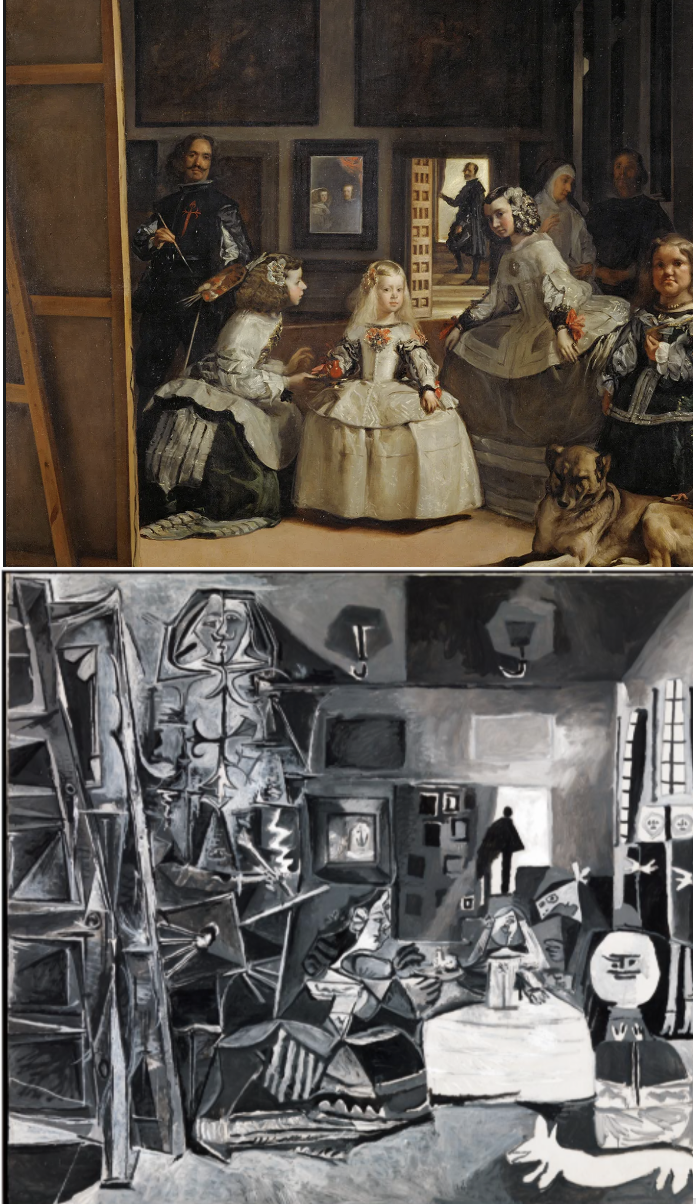
I have long been a fan of realism in the realm of art. In high school, I once saw the portrait of a girl in the St. Louis Art Museum that I could have sworn was a photograph until I came within a foot of the piece and realized it was a painting. Wow. How could the artist pull off such a feat? To reproduce with a paint brush what I would have mistaken as the work of a camera lens. Filled with awe and wonder, I knew I could never aspire to such a thing. I felt more at home in the room dedicated to Picasso’s work. I am pretty good at painting circles and rectangles and people in the shape of stick figures.
At least I thought so. Until this past week. When after going to the Museo Picasso in Barcelona I got into my mind that I should give a stab at Cubism. It all began like this:
Me (standing in front of one of Picasso’s 48 oil paintings of Las Meninas): “I can do that.”
Sheila (standing next to me): “You think so, huh?”
Me: “How hard can it be to paint a stick figure?”
Turns out slightly harder than it looks. I decided Sheila needed a Cubist portrait of us in Barcelona and I got out my paint brushes and worked on it the last couple nights. Huh, indeed. It might make it onto her refrigerator with a magnet, but I don’t think it is going to be going into any art museums.
Cubism, I have recently learned (and yes, I realize I should remember this from high school!) is about more than drawing circles and rectangles and stick figures. It is about trying to look at an object from every angle all at the same time. Picasso’s 48 paintings of Las Meninas represent the artist’s attempt to get to the heart of fellow Spanish artist Diego Velazquez’s 1656 painting by this same title. Velazquez’s painting is the portrait of a young girl being addressed by royal servants in the palace of Philip IV. The original painting is now located in The Prado Museum in Madrid and looks very realistic. Like a vivid snapshot of palace life in the 17th century. Picasso’s version of Velazquez’ painting bears no resemblance.
At least at first glance.
Me: “What on earth is going on here?”
Sheila: “It is Picasso’s rendition of Velazquez’ Las Meninas at the Prado”
Me: “Who is Velazquez? What is Las Meninas?”
(Shows me the original on her phone)
Me: “That looks nothing like Las Meninas.”
Sheila: “Look again.”
Well, an hour later, having looked at not only the main Picasso rendition of Las Meninas but the 47 additional Picasso paintings of different aspects of Velazquez’ original, I finally kinda got it. I could see the genuine effort and persistence it takes to approach a scene from multiple angles, all at the same time. And, in the end, which one was more a representation of the reality? Velazquez or Picasso?
Thomas Aquinas defines truth like the philosopher Aristotle: “Veritas est adaequatio rei et intellectus.”[i] Literally translated, “Truth is the adequation of thing and intellect.” A bit dense. But what Aquinas means here is that truth is having a mind aligned with reality. It is having a picture of the world in front of you that matches how that world really is. You don’t want to be seeing things that are not really there, and you do want to be able to see accurately the things that are there.
But when there is much there, who has the greater “adequation of thing and intellect” going on in their head—the Realist or the Cubist? Are we more closely aligned with reality when we can see clearly the royal princess and her attendants directly in front of us? Or when we are looking at the same scene from multiple angles all at once, even though they are layered on top of one another to produce a royal prin-mess?
In the end, no piece of art is itself true. Truth only exists in the human mind. Art is a composition of color on canvas or words spilt out onto a page with ink. But genuine art intends to help the person on the quest for truth to understand reality both more crisply or more broadly than they may have caught previously with their own eyes. Both approaches to Las Meninas—referring literally to the girl’s attendants in the picture—have value, either in sharpening our attention or expanding our imagination. I think for most of my life I’ve had greater appreciation and respect for the work of the Realists of the world. How much skill it must take to paint what looks like a photograph of life itself! Such care of detail! Yet, I wonder if in society at large the greatest need of the present moment isn’t to work on our Cubist skills—i.e. the ability to look at the reality of a situation from multiple angles all at once and hold them together even though it feels like a mess.
Sheila herself is wonderful at this form of art in daily life. The book she co-authored called Difficult Conversations: How to Discuss What Matters Most has forever aided my own capacity to look at the same event from different perspectives and be able to talk with others about why we can see things so differently. If you’ve never read it before I very, very much recommend it. I also write a bit about a tool she taught me called the Ladder of Inference in one of my essays on truth found here. But I think even she would say that looking at things from a Picasso lens does not always come easily and requires ongoing inspiration.
That is why there is a wonderful piece of kindergarten-like art headed in Sheila’s direction. I am happy to report that in real life (vs. my painting), her nose is not on one side of her face with her eyeballs on the other. And her hair does not look like lightning bolts shooting from her scalp. Moreover, in real life I have more than one ear. But I hope she appreciates that, while I am still developing my Picasso skills over here, I see her—and many of you out there—modeling the Herculean task of at looking at reality from an ever-widening set of perspectives and am filled with wonder and awe. It is harder work than it looks like it should be, and is under-appreciated in today’s world, but is still much needed in the necessary ongoing quest for truth.
[i]Thomas Aquinas, Summa theologiae I, Q. 16, A. 1